Key takeaways
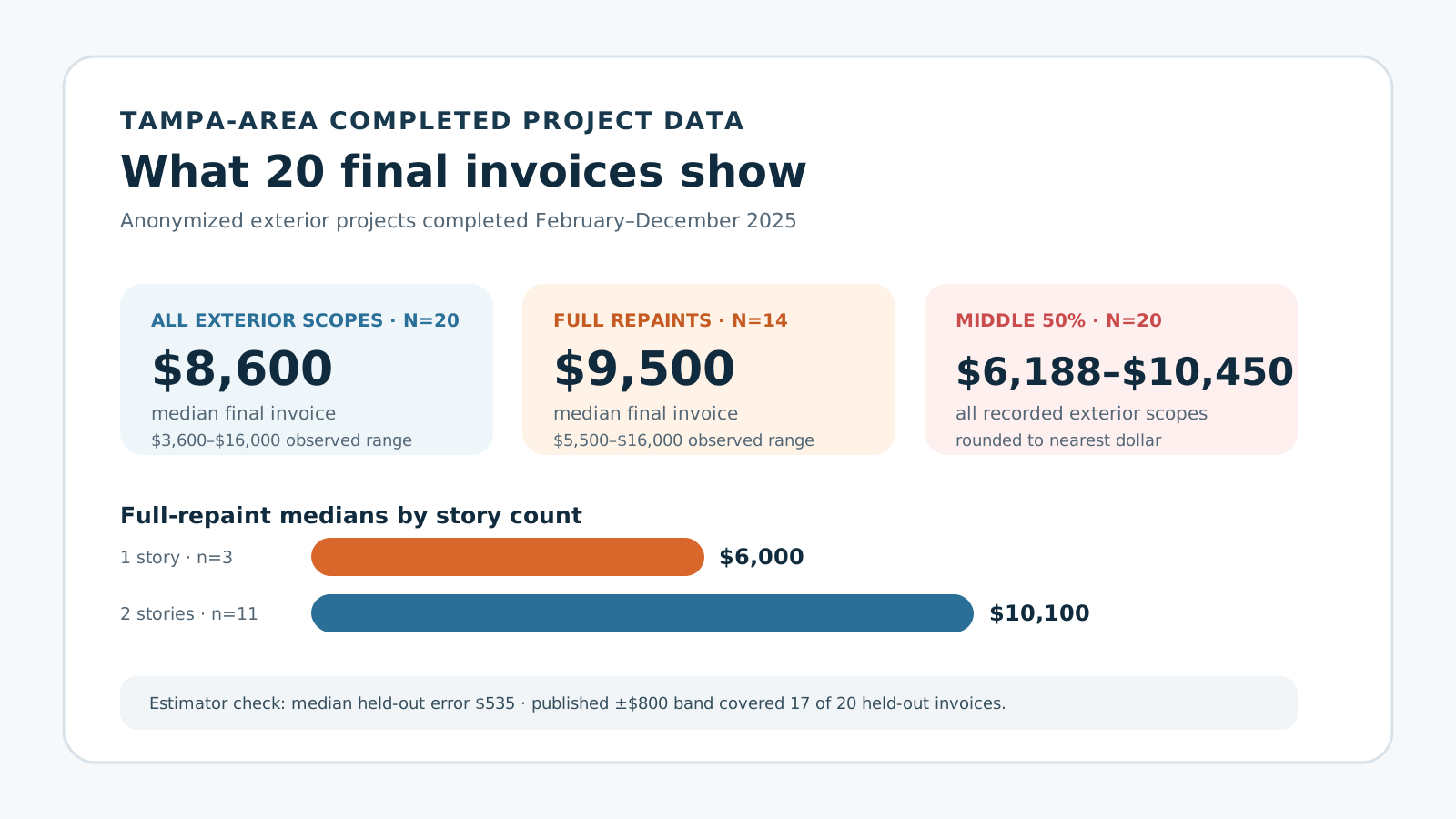
- The 20 completed projects had a $8,600 median and $8,590 mean final invoice.
- The middle 50% of all recorded scopes ran from $6,188 to $10,450.
- The 14 full repaints had a $9,500 median; sealing and partial work should not be compared with full repaints.
- Fourteen of 20 projects (70%) recorded a nonzero repair cost.
- A fixed proposal still requires measured paintable area, a defined surface list, and an onsite condition review.
Expanded first-party findings
| Measure | Result | Interpretation limit |
|---|---|---|
| Data period | February 14–December 1, 2025 | Completion dates, not proposal dates |
| All completed scopes | n=20; mean $8,590; median $8,600 | Includes full, partial, sealing, and recoat work |
| Lowest / highest qualifying invoice | $3,600 / $16,000 | Observed records, not advertised prices |
| One story / two stories | n=8; median $5,750 / n=12; median $10,000 | All scopes; not adjusted for size, condition, or access |
| Excellent / good condition | n=3; median $9,900 / n=7; median $8,500 | Small, unadjusted groups with different homes and scopes |
| Fair / poor condition | n=7; median $6,400 / n=3; median $13,700 | The fair group includes lower-cost scopes |
| Projects with recorded repairs | 14 of 20 (70%); $700 median positive repair cost | Repair dollars only; repair type was not classified |
| Primer recorded | 14 of 20 (70%) | Does not distinguish spot from full priming |
| Acrylic versus elastomeric systems | Not reportable | Products were recorded by line, but coating family was not normalized |
First-party completed-project dataAll 20 rows passed the arithmetic check that original estimate plus change orders equaled final invoice. Subgroup figures are descriptive and unadjusted.
Estimate a comparable Tampa-area exterior project
This model uses the four predictors that remained stable in leave-one-out testing: living area, existing condition, access, and scope. It produces a planning band, not a contractor quote.
Comparable to the model's training range. Confirm substrate, stories, repairs, measured paintable area, and coating system onsite.
- Living-area component
- $5,065
- Condition adjustment
- $607
- Access adjustment
- $2,191
- Scope adjustment
- $3,387
- Calibration intercept
- −$2,457
- Raw model center
- $8,793
- Published center after guardrails
- $8,793
- Published uncertainty band
- ±$800
Test result: median absolute held-out error $535; mean absolute held-out error $549; median absolute percentage error 5.35%; the published ±$800 band covered 17 of 20 held-out invoices. These results describe this small internal sample and are not an independent market audit.
Calculator-derived planning estimateThe displayed components use coefficients calibrated on the 20 completed invoices. The intercept is a model calibration term, not a standalone project charge.
Actual ranges in the completed-project sample
| Project group | Sample | Observed range | Median final invoice |
|---|---|---|---|
| All exterior scopes | 20 | $3,600–$16,000 | $8,600 |
| Full repaints | 14 | $5,500–$16,000 | $9,500 |
| One-story full repaints | 3 | $5,500–$6,400 | $6,000 |
| Two-story full repaints | 11 | $8,500–$16,000 | $10,100 |
Small subgroup warning: the one-story median is based on only three full-repaint records. It is descriptive, not a universal Tampa rate.
First-party completed-project dataRanges and medians use final invoices, including recorded change orders.
The estimate changes with prep, access, and scope
Surface condition
Cleaning, scraping, caulking, patching, priming, and repairs add labor before the finish coat begins. The sample's poor-condition projects carried the heaviest prep and repair loads.
Access
Height, landscaping, tight side yards, roof lines, and equipment setup affect productive labor time. The estimator treats access separately from house size.
Included surfaces
Walls-only work is not comparable with walls, trim, soffits, garage doors, shutters, fences, or pool structures. Every quote should name inclusions and exclusions.
Coating system
Substrate, existing finish, primer requirements, finish coats, film build, and product instructions should determine the coating system—not a generic promise that one product fits every exterior.
Why does professional exterior painting cost this much?
The supplied records show substantial labor, preparation, and repair inputs, but they do not split invoices into labor, paint, overhead, equipment, or warranty percentages. The page therefore reports only the captured fields and does not invent a percentage breakdown.
| Budget input | Recorded finding | What the dataset does not establish |
|---|---|---|
| Preparation | 20 median recorded prep hours | Whether prep hours overlap the labor-hours field |
| Labor | 69 median recorded crew labor hours | Crew size, wage rates, and elapsed workdays |
| Repairs | 14 of 20 projects; $700 median when positive | Repair type or material/labor split |
| Primer | Recorded on 14 of 20 projects | Spot versus full prime quantities |
| Finish coats | 15 of 20 recorded two finish coats | Actual gallons or application loss |
| Change orders | 10 of 20 projects; $475 median when positive | Whether a change was owner-requested or concealed-condition work |
A complete proposal may also need to cover paint and primer, masking and protection, access equipment, supervision, business overhead, cleanup, final inspection, and warranty obligations. Those categories are real planning considerations, but this dataset cannot assign each one a defensible percentage.
First-party completed-project dataMedians are descriptive across all 20 scopes and should not be added together as separate invoice charges.
How much exterior paint does a house need?
Paint quantity should start with measured paintable surface area, not conditioned living area. Multiply paintable area by the number of coats, then divide by an adjusted spread rate that accounts for texture, porosity, application loss, and the product data sheet.
Example: if the measured wall area is 1,000 square feet, the scope calls for two coats, and the planning assumption is 300 effective square feet per gallon, the calculation is 2,000 ÷ 300 = 6.7 gallons. Round the purchase plan to 7 gallons before separate trim, primer, touch-up, and waste allowances.
BEHR currently publishes a 250–400-square-foot-per-gallon range for Premium Plus Exterior, while also noting that a primer coat may be needed on some surfaces.[6] Rough or porous stucco can reduce effective field coverage, so use the selected product's current label and substrate instructions.
Calculator-derived example + manufacturer guidanceThe 300-square-foot example is an illustrative planning assumption, not a guaranteed spread rate or a project quote.
How long does an exterior repaint take in Tampa?
This dataset cannot support a reliable calendar-day range because it records labor and preparation hours, but not crew size, start and finish timestamps, drying intervals, or weather delays. Its median project recorded 69 crew labor hours and 20 preparation hours.
Ask the proposal to state
- Expected crew size and working days
- Wash-to-paint drying plan
- Repair and cure-time assumptions
- Product-specific recoat windows
Ask what can extend it
- Rain, wind, or unsuitable surface moisture
- Hidden stucco or wood deterioration
- Restricted access and protection setup
- Color, scope, or owner-requested changes
First-party data limitationLabor and prep medians are reported separately because the data dictionary does not establish whether those fields overlap.
Two completed Tampa project records
These records were marked approved for publication in the supplied dataset. Customer names and street addresses are not included.
HC-1001 · Two-story stucco repaint
- Completed
- February 2025
- Service area
- Tampa
- Home size
- 2,450 living sq. ft.; 3,100 paintable exterior sq. ft.
- Condition/access
- Good; moderate access
- Scope
- Walls, trim, and soffits; deck and roof excluded
- Prep/repair
- 22 prep hours; $450 repairs
- System
- Primer plus two finish coats; Sherwin-Williams SuperPaint recorded
- Labor
- 68 crew labor hours
- Price
- $8,200 estimate + $300 change order = $8,500 final
HC-1005 · Repair-intensive stucco repaint
- Completed
- April 2025
- Service area
- Tampa
- Home size
- 2,750 living sq. ft.; 3,400 paintable exterior sq. ft.
- Condition/access
- Poor; difficult access
- Scope
- Walls, trim, and soffits; windows excluded
- Prep/repair
- 36 prep hours; $1,800 repairs
- System
- Primer plus two finish coats; Sherwin-Williams Emerald recorded
- Labor
- 96 crew labor hours
- Price
- $12,500 estimate + $1,200 change order = $13,700 final
Exterior project photographs
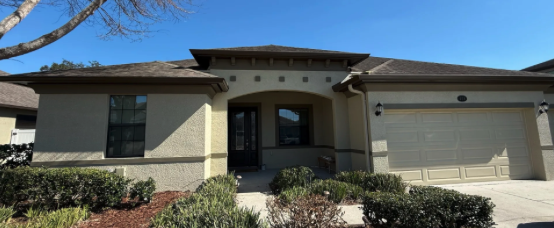
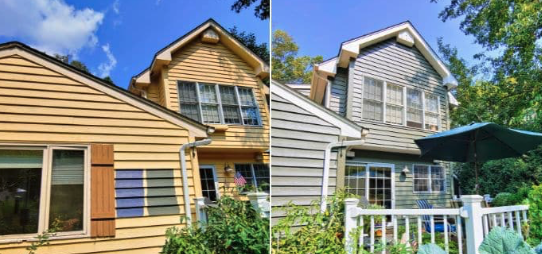
These two images were supplied for this page. The upload did not identify a project ID, location, completion date, or price, so the page does not associate either image with the priced records above.
What should a Tampa exterior painting quote identify?
| Quote item | What to verify |
|---|---|
| Measurement | Living area, paintable exterior area, or another basis—and which one drives price. |
| Preparation | Washing, scraping, sanding, caulking, patching, mildew treatment, and bare-spot priming. |
| Repairs | Whether stucco, wood, trim, or moisture-related repairs are included, allowances, or change orders. |
| Surfaces | Walls, trim, fascia, soffits, doors, garage doors, shutters, porch ceilings, fences, decks, and pool structures. |
| Coating system | Manufacturer, product line, primer, number of finish coats, application method, and required coverage or film build. |
| Protection and cleanup | Landscaping, windows, roofs, walkways, vehicles, overspray control, debris, and final walkthrough. |
Illustrative side-by-side comparison
| Scope item | Quote A | Quote B |
|---|---|---|
| Washing | Included | Included |
| Mildew treatment | Not specified | Included where observed |
| Stucco cracks | “As needed” | Defined allowance and unit price beyond it |
| Primer | “As needed” | Spot-prime locations and product named |
| Finish coats | One coat | Two complete coats |
| Fascia and soffits | Not specified | Included |
| Comparison status | Incomplete scope | More auditable scope |
The lower total is not necessarily the lower equivalent price. Ask both bidders to price the same surfaces, prep, repairs, primer, finish coats, protection, and change-order rules before comparing.
Editorial exampleThe example is not a customer bid, completed project, or advertised offer.
Permits, historic review, contractor checks, and lead-safe work
Ordinary painting
The City of Tampa Construction Services FAQ lists painting and similar finish work among activities that do not require a permit. Repairs or structural work can be different, so verify the actual scope.[1]
Historic properties
Tampa's Architectural Review and Historic Preservation program reviews work in designated districts. Confirm whether a property or proposed change needs review before scheduling.[2]
Contractor verification
Hillsborough County directs owners to HillsGovHub and Florida DBPR resources to check credentials applicable to regulated work. Ask for current insurance documentation and a written scope.[3]
Pre-1978 painted surfaces
EPA's Renovation, Repair and Painting Rule can apply when paid work disturbs paint in pre-1978 housing or child-occupied facilities. Verify firm and renovator requirements before work.[4]
Cost methodology, sample size, and estimator testing
- Sample. The analysis used 20 anonymized completed exterior-project records dated February 14 through December 1, 2025. Service areas included Tampa, Brandon, Riverview, Plant City, Valrico, Apollo Beach, and Seffner.
- Price definition. Final invoice price was the target. Every row passed the check original estimate + change orders = final invoice.
- Scope. The sample includes 14 full repaints plus partial repaint, paint-and-seal, seal-only, and clean-and-recoat jobs. Aggregates are labeled so unlike scopes are not presented as equivalent.
- Privacy and publication. All 20 anonymous records were used for aggregate analysis and estimator testing. Seventeen were marked approved for publication; only approved records are described individually.
- Model. A small ridge-regression model uses living area, condition, access, and scope. Story count and substrate were retained as quote-check factors but excluded from the public formula because they did not improve stable held-out performance in this 20-record sample.
- Testing. Leave-one-out testing fitted the model 20 times, holding out a different invoice each time. Median absolute error was $535, mean absolute error was $549, root mean squared error was $649, and median absolute percentage error was 5.35%.
- Published range. The estimator displays the model prediction plus or minus $800 and does not extend past the sample's $3,600–$16,000 observed range. That band covered 17 of 20 held-out invoices.
- Uncaptured fields. The records do not provide material-cost allocations, crew size, elapsed workdays, weather delays, paint gallons, or a normalized acrylic/elastomeric classification. The page does not calculate those missing values from product names.
- Evidence separation. Completed-project results, estimator outputs, editorial examples, manufacturer guidance, and regulatory statements are labeled separately. External contractor ranges are bibliography context only and are not blended into the first-party statistics.
Who prepared and reviewed this guide?
Organizational author
Polk Premium Exteriors prepared and published this page as a company-authored exterior-painting resource.
Technical-review disclosure
No individual technical reviewer is named on this edition, so the page makes no person-level credential, license, certification, or years-of-experience claim.
Regulatory statements link directly to government sources, and product statements link to manufacturer materials. This guide is not legal or engineering advice.
Authorship disclosureA named reviewer biography should be added only after the reviewer, role, credentials, profile URL, and review performed are genuinely documented.
What two customers said
These comments were supplied for this page. No star rating, platform, review date, or aggregate score was provided, so none is claimed in the page or structured data.
“PPE and they were absolute rockstars! The team showed exceptional expertise, meticulous attention to detail, and brought my vision to life with precision. Their excellent communication, professionalism, and approachable nature made the entire experience enjoyable”
“Did excellent job with drywall repair and paint job in my condo in Tampa. Explained what they would do and followed through. Showed up on time, color and texture matched my existing paint, and left the site spotless.”
Primary, manufacturer, and current contractor sources
Project prices and estimator metrics come from the 20 supplied final invoice records. The links below support regulatory, product, and external market-comparison statements.
| Source class | Used for | Not used for |
|---|---|---|
| First-party completed records | Local invoices, scope, labor, prep, repairs, and estimator testing | Universal Tampa market rates |
| Government sources | Permit, historic-review, credential-check, and lead-safe requirements | Painting-price estimates |
| Manufacturer materials | Product use, coverage, preparation, and application guidance | Property-specific system selection without inspection |
| Contractor-published market pages | Broad comparison context | Blending into the first-party statistics |
| Forums and homeowner anecdotes | Not used on this edition | Authoritative price or technical claims |
- [1] Government. City of Tampa Construction Services FAQ — identifies painting and similar finish work as not requiring a permit.
- [2] Government. City of Tampa Architectural Review and Historic Preservation — official review program and district resources.
- [3] Government. Hillsborough County contractor-selection guidance — official credential-check links.
- [4] Government. U.S. EPA Renovation, Repair and Painting program — certification and lead-safe requirements for covered work.
- [5] Manufacturer. Sherwin-Williams Loxon XP masonry coating — current manufacturer product and data-sheet access.
- [6] Manufacturer. BEHR Premium Plus Exterior and BEHR Ultra Exterior — current manufacturer coverage, preparation, use, and data-sheet access.
- [7] Manufacturer. BEHR masonry, stucco, and brick coatings — current manufacturer masonry options.
- [8] Contractor-published market context. Westchase Painting Tampa Bay planning ranges, Premier Contractors FL Tampa ranges, and Fenelon Handyman Tampa range — accessed July 26, 2026; not used to calculate this page's first-party figures.
Revision history
| Date | Substantive change |
|---|---|
| July 27, 2026 | Revised the opening cost guidance and headline, removed the prior direct-answer block, and aligned visible and structured metadata. |
| July 26, 2026 | Published the 20-project cost dataset analysis, validated estimator, two approved anonymous project records, supplied project images, and primary-source hiring guidance. |
| July 26, 2026 | Added expanded descriptive statistics, evidence labels, estimator components, budget anatomy, paint-quantity calculation, duration limitations, quote comparison, source policy, authorship disclosure, responsive images, and related resources. |
Editorial recordThe modified date changes only when this page receives a substantive content or methodology update.
Frequently asked questions
How much did the completed Tampa-area exterior projects cost?
Across the 20 anonymized exterior projects in this guide, final invoices ranged from $3,600 to $16,000. The median was $8,600. The sample combines full repaints, partial repaints, sealing, and clean-and-recoat work.
What did full exterior repaints cost?
The 14 full repaints ranged from $5,500 to $16,000, with a median final invoice of $9,500.
Can the estimator quote a 2,000-square-foot home?
The estimator gives a planning range, not a quote. It combines living area with documented condition, access, and scope effects from the 20-project sample.
Does ordinary exterior painting require a City of Tampa permit?
The City of Tampa says painting and similar finish work does not require a permit. Associated repairs, structural work, or work on a designated historic property may trigger separate requirements.
What should owners of pre-1978 homes ask about?
EPA's Renovation, Repair and Painting Rule applies when paid work disturbs paint in most pre-1978 housing and child-occupied facilities. Covered firms and renovators must meet certification and lead-safe work-practice requirements.
How was the estimator tested?
Each of the 20 projects was held out once while the model was fitted to the other 19. The median absolute error was $535, and a plus-or-minus $800 planning band covered 17 of the 20 held-out invoices.
How much paint is needed for a 1,000-square-foot house exterior?
Living area alone does not determine paint quantity. If the measured paintable surface is 1,000 square feet, two coats are planned, and the adjusted coverage assumption is 300 square feet per gallon, the calculation is 2,000 divided by 300, or 6.7 gallons. Round to 7 gallons before separate primer, trim, touch-up, and waste allowances.
How many days does a Tampa exterior repaint take?
The supplied dataset cannot support a calendar-day range because it does not record crew size, elapsed workdays, drying intervals, or weather delays. Ask each proposal to state expected crew size, working days, repair assumptions, recoat windows, and weather-delay rules.